Bulk SMS Gateway in India: Features, Benefits and Uses
What a bulk SMS gateway is, how it works in India, the features to look for and how businesses use an SMS gateway for OTPs, alerts and campaigns.
 Bulk SMS India Team Updated 10 June 2025 5 min read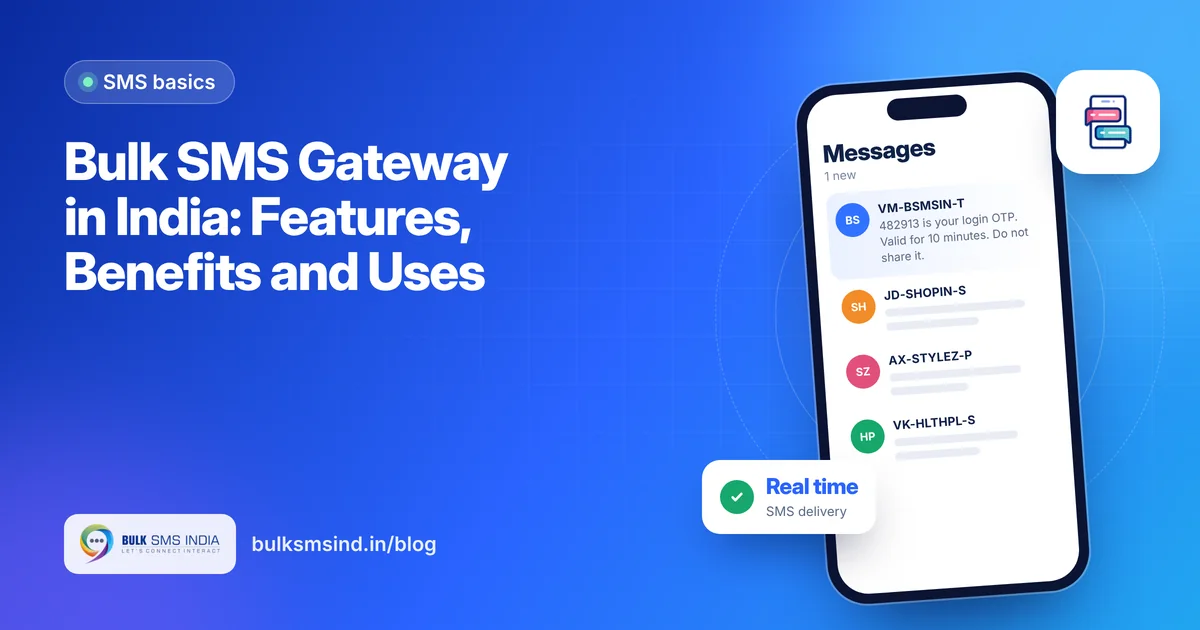
Every OTP, bank alert and festive offer that lands on your phone passes through a bulk SMS gateway. If your business sends more than a few hundred messages a day, the gateway you use decides how fast those messages arrive, how many actually reach customers and how much you pay for each one.
This guide explains what a bulk SMS gateway in India is, how it works, which features matter and where businesses use it.
What is a bulk SMS gateway?
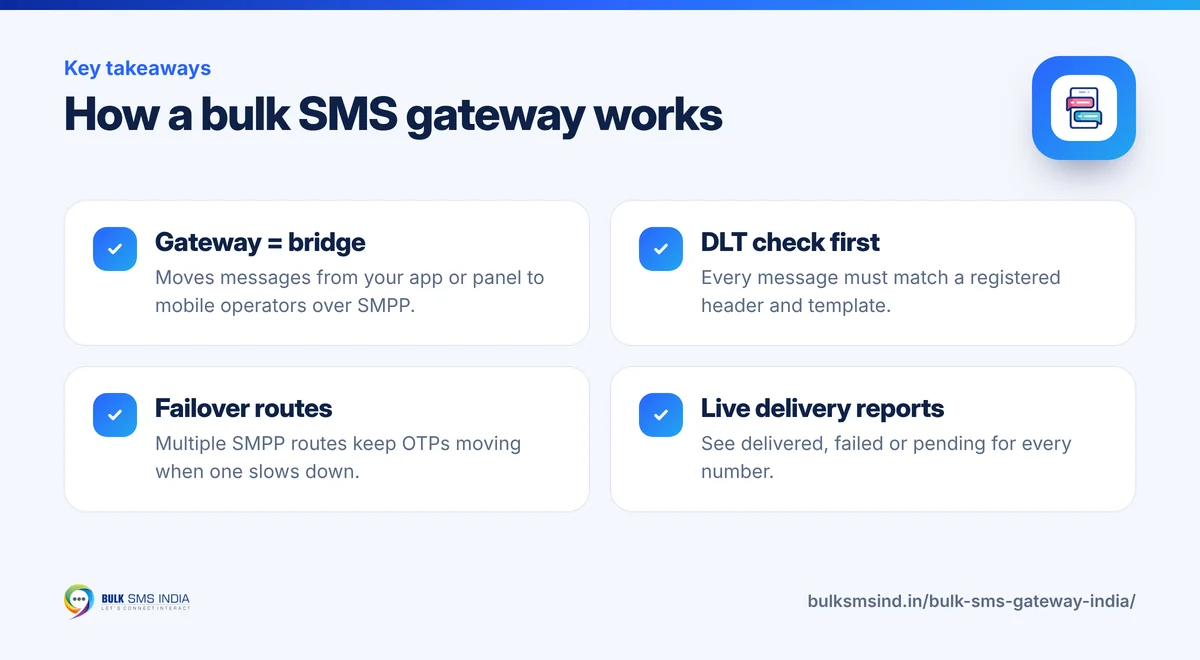
A bulk SMS gateway is the software and network connection that takes a message from your application, website or panel and hands it to a mobile operator for delivery. Think of it as the bridge between the internet, where your systems live, and the telecom network, where your customers' phones live.
When you click Send in an SMS panel or call an SMS API, the gateway:
- Accepts the message, the recipient numbers and your sender ID.
- Checks it against your registered DLT template and header.
- Picks the best operator route for each number.
- Submits the messages to operators over SMPP connections.
- Receives a delivery report (DLR) back for every message and shows it to you.
All of this happens in a few seconds. On Bulk SMS India messages are delivered in real time.
How an SMS gateway works in India
India has an extra layer most countries do not: DLT (Distributed Ledger Technology) scrubbing. Every commercial SMS must match a sender ID (header) and a content template registered by the business on an operator's DLT portal. The gateway sends the message along with your DLT entity ID and template ID, and the operator checks it before delivery. If the content does not match the approved template, the message is blocked.
A good gateway therefore does two jobs: it moves messages quickly, and it makes sure every message is DLT-compliant before it leaves, so you are not paying for messages that will never arrive.
Features to look for in a bulk SMS gateway
| Feature | Why it matters |
|---|---|
| Multiple SMPP routes with automatic failover | If one route slows down or fails, traffic moves to another and delivery continues |
| Separate promotional, transactional and OTP routes | Each message type is handled with the right priority and rules |
| Live delivery reports (DLR) | You see delivered, failed and pending status for every number |
| HTTP API | Your website, app, CRM or ERP can send SMS automatically |
| DLT template and header management | Fewer rejected messages and faster campaign setup |
| Unicode support | Send messages in Hindi, Tamil, Bengali and other Indian languages |
| Scheduling | Messages go out at the time you choose |
| Uptime and redundancy | Your OTPs keep working during traffic spikes |
Bulk SMS India runs on 10+ SMPP backup servers hosted in Tier-4 data centres, with load-balanced routing that switches automatically when any route is under heavy load.
What your customer sees
- DLT-approved sender ID and template
- Submitted to operators in real time
- Live delivery report for every number
- Works on every mobile phone
Benefits of using a bulk SMS gateway
Reach everyone. SMS works on every mobile phone, smartphone or not, without internet or an app.
Speed. Time-sensitive messages such as OTPs and payment alerts arrive in seconds.
High open rates. People read text messages far more reliably than emails, often within minutes.
Automation. With an SMS API, alerts go out the moment an order is placed, a payment is made or an appointment is booked.
Low cost per message. Bulk SMS remains one of the cheapest ways to reach thousands of customers. See our bulk SMS pricing for current rates.
Common uses of an SMS gateway
- OTP and verification for logins, sign-ups and payments
- Transaction alerts for banks, NBFCs and wallets
- Order and delivery updates for e-commerce and logistics
- Appointment reminders for hospitals, clinics and salons
- Fee reminders and results for schools and coaching institutes
- Promotional campaigns for retail, real estate and events
Gateway, panel or API: which do you need?
They are three parts of the same system. The gateway is the engine. The panel is a web dashboard where you upload contacts, write messages and see reports, which suits marketing and operations teams. The API lets developers send SMS from code. Most businesses use both: the panel for campaigns and the bulk SMS API for automated alerts.
Choosing the right bulk SMS gateway provider
Ask any provider these questions before you sign up:
- How many SMPP routes do you have, and what happens if one goes down?
- Do OTPs travel on a separate, priority route?
- Can I see live delivery reports for every message?
- Will you help with DLT header and template registration?
- What is the real price per SMS at my volume?
If the answers are clear and backed by a free test, you are in good hands.
Frequently asked questions
Is a bulk SMS gateway the same as an SMS API?
Not exactly. The gateway is the system that delivers messages to operators. The API is the interface your software uses to send messages into that gateway.
Can I send SMS to DND numbers through a gateway?
Transactional and service messages can reach DND numbers. Promotional messages are delivered only to numbers that have not blocked that category or have given consent, as per TRAI rules.
Do I need DLT registration to use an SMS gateway in India?
Yes. Every business sending commercial SMS in India must register its entity, sender IDs and templates on a DLT platform before messages can be delivered.
Ready to get started?
Talk to our team about bulk SMS service — setup help, DLT guidance and test credits.
Messaging specialists with 10+ years of experience (since 2016) helping 15,000+ Indian businesses with bulk SMS, WhatsApp, RCS and voice communication.