TRAI SMS Regulations in India: DLT, Templates and Sender IDs
A plain-language guide to TRAI SMS regulations in India — TCCCPR, DLT, sender IDs, template categories, -P/-S/-T/-G suffixes, URL whitelisting and traceability.
 Bulk SMS India Team 5 min read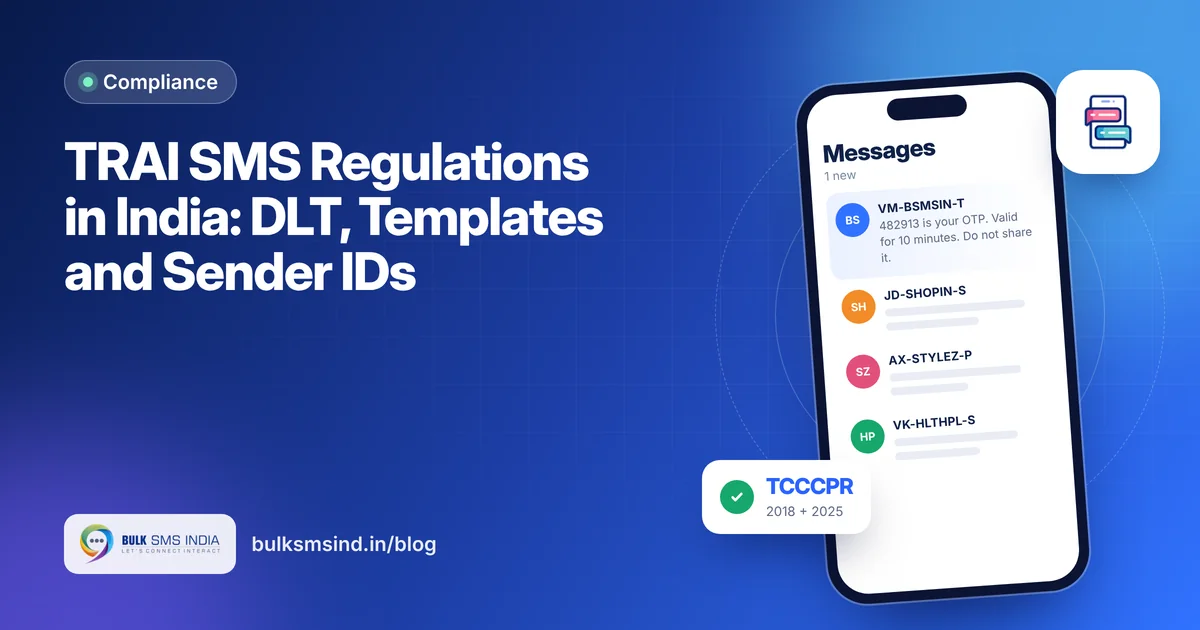
If you send business SMS in India, you are bound by TRAI SMS regulations. Over the last few years these rules have tightened steadily to fight spam and fraud. The good news: once your setup is right, compliance mostly runs in the background.
This guide explains the current rules in plain language.
The regulation behind it all: TCCCPR
TRAI's Telecom Commercial Communications Customer Preference Regulations (TCCCPR), 2018 govern all commercial SMS and calls in India. They introduced the DLT system and have been amended several times since, most recently in 2025.
The core idea is simple: every business that sends commercial messages must be registered, every message must match approved content, and every message must be traceable from sender to recipient.
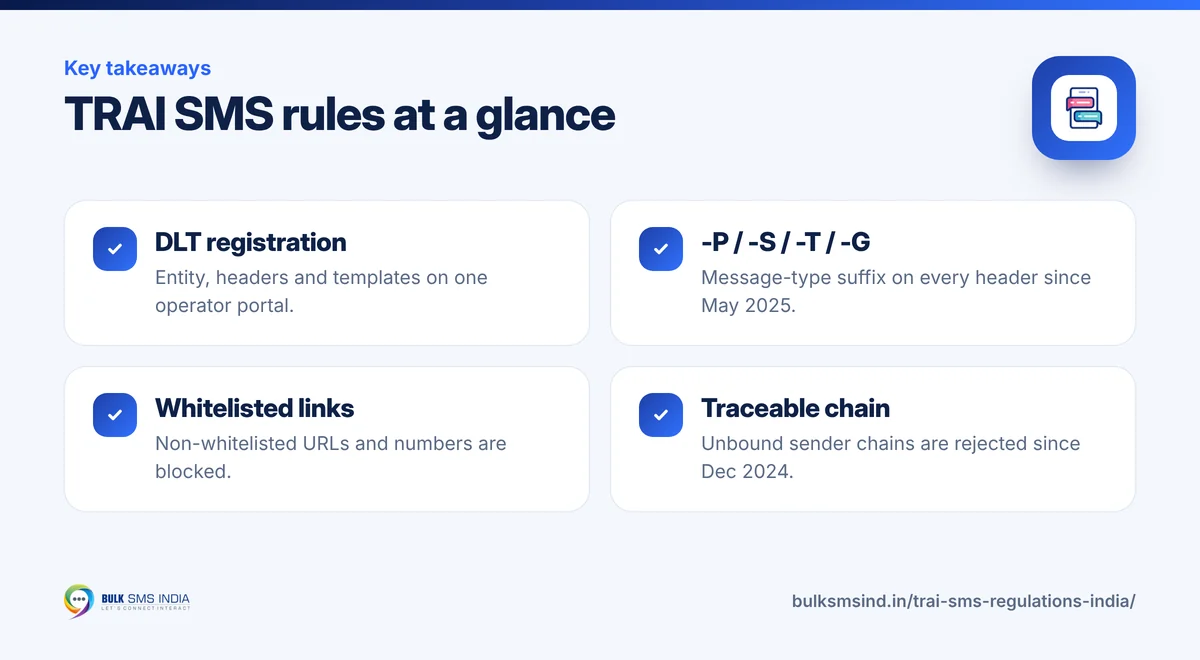
1. DLT registration
DLT (Distributed Ledger Technology) is a shared registry run by telecom operators. Businesses, called principal entities, register once on any operator's DLT portal (Jio, Airtel, Vi or BSNL). The registration is shared across all operators.
On DLT you register:
- Your entity – business details and documents.
- Headers (sender IDs) – the names customers see.
- Content templates – the exact message formats you will send.
- Consent templates – where you collect consent for promotional messages.
2. Sender IDs (headers)
| Message type | Header format |
|---|---|
| Transactional and service | 6-character alphabetic brand name, such as BSMSIN |
| Promotional | Numeric header |
Customers see the header with an operator prefix and, since May 2025, a category suffix.
What your customer sees
- DLT-approved sender ID and template
- Submitted to operators in real time
- Live delivery report for every number
- Works on every mobile phone
3. Template categories
Every message must match a registered template in one of these categories:
- Transactional – OTPs and critical alerts linked to a customer action.
- Service (implicit) – updates to existing customers about products or services they use.
- Promotional – marketing and offers.
- Government – messages from government bodies.
Variable parts of a template are marked as {#var#}. Everything else must be sent exactly as approved.
The Service Explicit category was discontinued in May 2025. Its templates moved to promotional, so they now follow promotional timing and DND rules.
4. The -P, -S, -T and -G suffixes
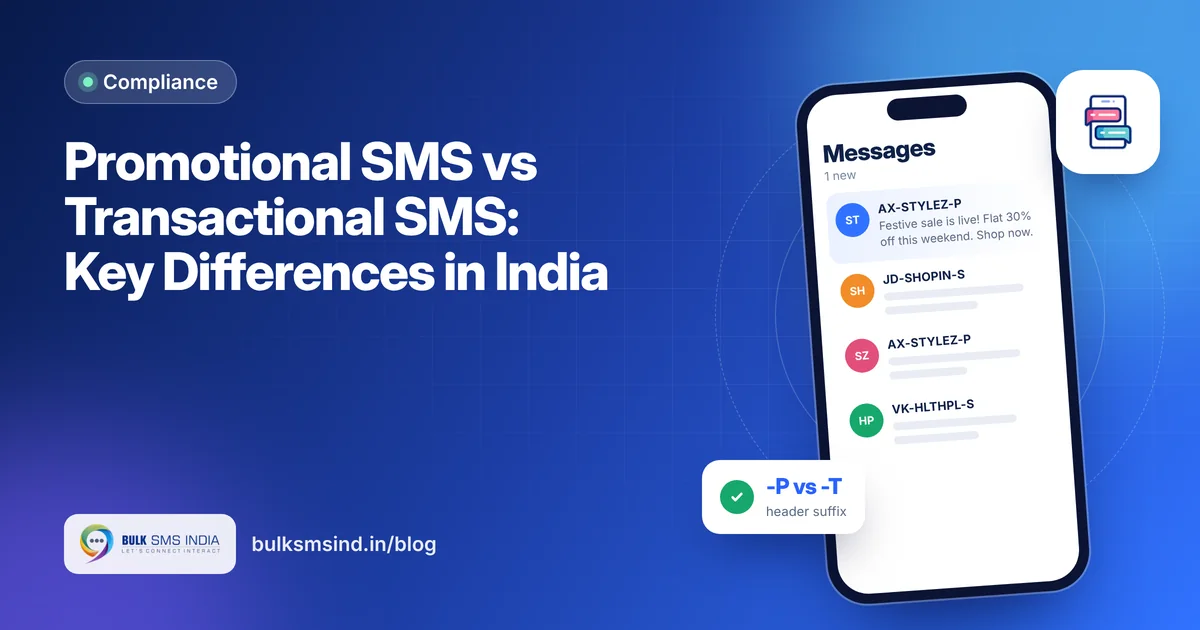
Under TRAI's 2025 amendment, from 6 May 2025 every commercial header carries a suffix showing the message type:
| Suffix | Meaning | Example |
|---|---|---|
| -P | Promotional | AX-123456-P |
| -S | Service | JD-SHOPIN-S |
| -T | Transactional | VM-BSMSIN-T |
| -G | Government | Government senders |
Operators add the suffix automatically based on your template category. Businesses do not need to re-register anything, but customers now see at a glance whether a message is an offer or an alert.
5. Promotional message rules
- Delivered only between 10 AM and 9 PM.
- Not delivered to customers who have blocked that category on DND, unless they have given digital consent.
- Should include a way for customers to opt out.
6. URL, APK and callback number whitelisting
Since 1 October 2024, operators block messages containing links, APK links, OTT links or callback numbers that are not whitelisted in the template. If a link has a fixed part and a variable part, the fixed part must be whitelisted. Short links must be whitelisted too.
7. Message traceability and chain binding
From 11 December 2024, every message must travel through a declared chain: principal entity → telemarketer (your SMS provider) → operator. Businesses bind their entity to their SMS provider on the DLT portal. Messages whose chain is undefined or does not match are rejected.
8. Complaints and penalties
Customers can report spam to their operator. Since the 2025 amendment, the complaint window is 7 days (it was 3). Senders who generate repeated valid complaints can have their headers, templates or entire traffic suspended. Keeping content honest and lists permission-based is the best protection.
Compliance checklist for businesses
- Entity registered on a DLT portal
- Sender IDs registered for each brand
- Templates registered in the correct category
- All links and callback numbers whitelisted
- Entity bound to your SMS provider (chain declared)
- Promotional messages scheduled between 10 AM and 9 PM
- Opt-out offered in promotional messages
- Consent records kept for promotional lists
How your SMS provider helps
A good provider checks content against your templates before sending, keeps OTPs on a dedicated route, and guides you through registration and chain binding. Bulk SMS India's team helps customers set up headers, templates and whitelisting. See our bulk SMS service.
This article explains the regulations in general terms and is not legal advice. Always check the latest TRAI directions and your operator's DLT portal.
Frequently asked questions
Is DLT registration mandatory?
Yes. Businesses sending commercial SMS in India must register on DLT. Messages from unregistered entities are not delivered.
Do I need separate DLT registration for each operator?
No. Registering on one operator's portal is enough; the data is shared across operators.
Why are my messages with links getting blocked?
The link is probably not whitelisted in your template. Add the domain or fixed part of the URL to your template's whitelist on the DLT portal.
Ready to get started?
Talk to our team about bulk SMS service — setup help, DLT guidance and test credits.
Messaging specialists with 10+ years of experience (since 2016) helping 15,000+ Indian businesses with bulk SMS, WhatsApp, RCS and voice communication.