RCS vs SMS vs WhatsApp: How AI Is Shaping the Future of Business Messaging
RCS vs SMS vs WhatsApp compared for Indian businesses: reach, features, cost, trust, compliance and the best use cases for each business messaging solution.
 Bulk SMS India Team 7 min read
Indian businesses now have three powerful ways to reach customers on their phones: classic SMS, rich RCS and WhatsApp. Each has strengths, and the best results come from using the right channel for the right message. This guide compares RCS vs SMS vs WhatsApp so you can build a messaging mix that grows your business.
The three channels in one line each
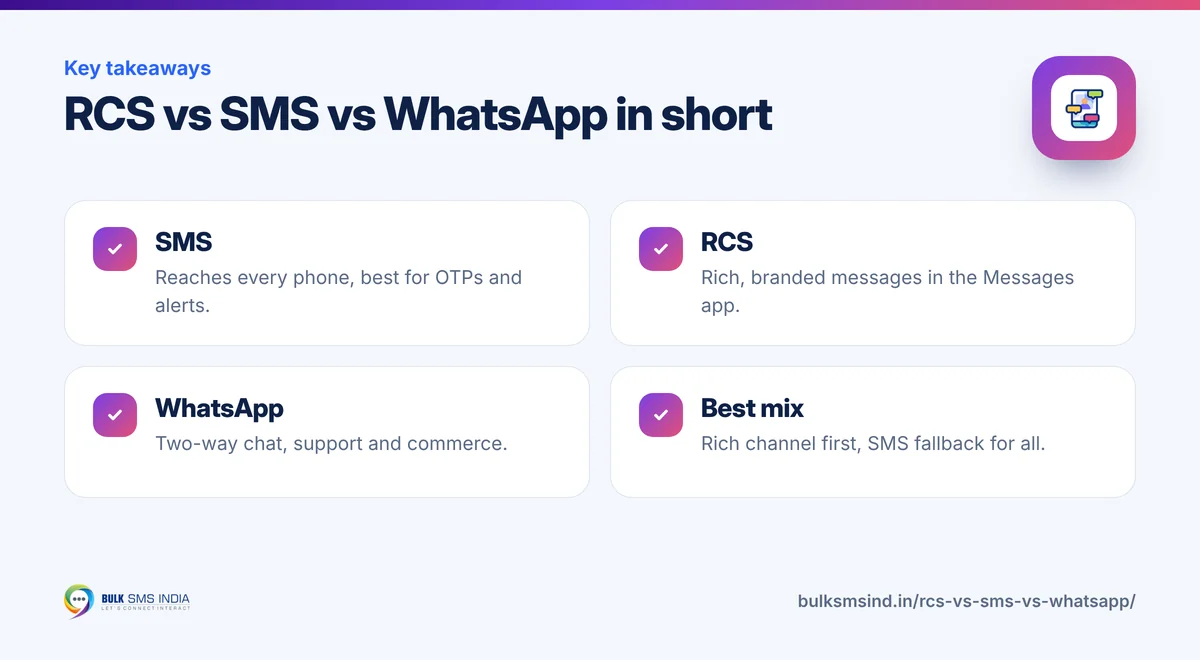
- SMS reaches every mobile phone in India, instantly, with no internet needed. It is the backbone for OTPs and alerts.
- RCS (rich communication services) upgrades SMS in the Android Messages app with your logo, images, carousels and buttons.
- WhatsApp Business reaches India's largest chat audience with rich, two-way conversations inside WhatsApp.
Side-by-side comparison
| SMS | RCS | WhatsApp Business API | |
|---|---|---|---|
| Reach | Every mobile phone | RCS-capable phones, SMS fallback | WhatsApp users who opted in |
| Internet needed | No | Yes (falls back to SMS) | Yes |
| Branding | Sender ID | Logo, name, verified badge | Business profile, verified badge |
| Rich media | No | Images, video, carousels | Images, video, documents, catalogues |
| Buttons | Links only | Action buttons, suggested replies | Quick replies, call-to-action buttons, lists |
| Two-way chat | Basic replies | Yes | Yes, with live agents and chatbots |
| Approval needed | DLT entity, header, template | Brand verification | Meta business verification, message templates |
| Best for | OTPs, alerts, mass reach | Branded promotions, rich alerts | Conversations, support, commerce |
RCS vs SMS
SMS wins on reach and reliability: it works on every phone, even without data, which is why banks and apps still send OTPs by SMS. RCS wins on experience: a product card with a Buy now button gets far more taps than a text link.
The good news is you do not have to choose. An RCS campaign with automatic SMS fallback gives rich content to RCS users and a plain SMS to everyone else. Learn how SMS routes work in our guide to promotional vs transactional SMS.
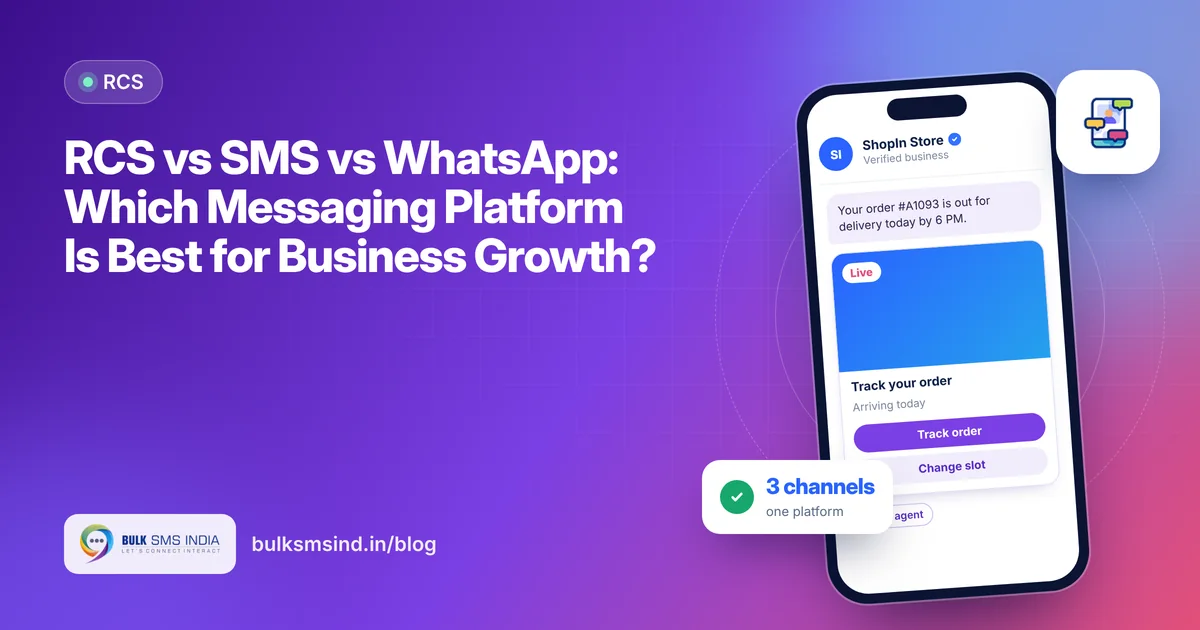
What your customer sees
- Verified brand name and logo
- Rich card with image and price
- One-tap buttons and suggested replies
- Automatic SMS fallback
RCS vs WhatsApp Business
Both offer rich media and buttons, so the difference is where and how customers engage:
- RCS reaches people in the default Messages app, with no opt-in to a separate app. It suits broadcast-style alerts and promotions.
- WhatsApp is where Indian customers chat every day. It shines for conversations: support, order updates, payments and chatbots.
WhatsApp requires customer opt-in and approved templates for business-initiated messages, while RCS requires brand verification. Many brands use RCS for discovery and promotions, and WhatsApp for service and repeat engagement.
Cost comparison
- SMS is the lowest-cost channel per message, and pricing depends on route and volume.
- RCS costs more than SMS per message because it carries rich content, and pricing depends on message type.
- WhatsApp Business API follows Meta's per-message pricing by category (marketing, utility, authentication), plus your provider's platform fee. Replies inside an open 24-hour customer service window are free.
The cheapest message is not always the best value. Measure cost per click, cost per order and cost per resolved query, not just cost per message.
Which channel for which message?
| Message | Best channel | Backup |
|---|---|---|
| OTP and login codes | SMS | RCS or WhatsApp authentication |
| Transaction and bank alerts | SMS | RCS |
| Order and delivery updates | SMS | |
| Flash sales and product launches | RCS | SMS |
| Abandoned cart reminders | WhatsApp or RCS | SMS |
| Customer support | Voice call | |
| Appointment reminders | WhatsApp or RCS | SMS |
Building a multi-channel strategy
- Start with SMS for anything time-critical, so every customer is covered.
- Add RCS to make promotions and alerts more visual and clickable on Android phones.
- Use WhatsApp for two-way conversations, support and commerce with opted-in customers.
- Use smart fallback: try the richer channel first and fall back to SMS when it fails.
- Track results per channel and move budget to what drives sales.
Bulk SMS India gives you bulk SMS, RCS messaging and WhatsApp messaging from one account, so you can run all three without juggling vendors.
How AI is shaping business messaging
The channel decides how a message looks. AI is starting to decide what the message says, who gets it and when. Here is how that plays out on each channel.
Rich cards and interactive messaging
RCS business messaging turns a plain text into a branded card with an image, a title, a short description and buttons such as “Buy now”, “Track order” or “Call us”. Carousels let customers swipe through several products. WhatsApp offers similar interactivity with buttons, lists and catalogues. These formats give AI something to work with: it can pick which product, image and button to show each customer.
Personalisation at scale
Instead of one message for everyone, AI can group customers by what they bought, browsed or clicked, and fill in the offer, product and timing that fit each group. On SMS this means better wording and variables inside an approved template. On RCS and WhatsApp it can also mean a different card or catalogue for each customer.
AI-powered campaigns
- Channel choice: send RCS to Android users who can receive it, WhatsApp to opted-in customers, and SMS to everyone else.
- Send-time suggestions: schedule messages for when each group usually responds.
- Reply handling: read replies and button taps, tag intent and route hot leads to sales.
- Testing: compare two versions of a card or message and keep the one that performs better.
Conversational AI in chat channels
Because RCS and WhatsApp are two-way, customers reply. An AI chatbot can answer these replies instantly, suggest the next option as buttons, and hand over to a person when needed. SMS remains the reliable fallback that reaches every phone.
A practical setup for 2026
- SMS for OTPs, critical alerts and as the fallback for every journey.
- WhatsApp Business API for support, order updates and conversations with opted-in customers.
- RCS for branded, visual campaigns and interactive offers on Android.
- AI on top to choose the channel, personalise content and answer replies.
For the bigger picture, see our guides on AI-powered CPaaS and omnichannel communication platforms.
Frequently asked questions
Will RCS replace SMS in India?
Not soon. RCS is growing fast, but SMS still reaches every phone without internet. The smart approach is RCS with SMS fallback.
Is WhatsApp better than SMS for marketing?
WhatsApp offers richer, two-way engagement with opted-in customers, while SMS offers universal reach. Most businesses get the best results by using both.
Which channel is best for OTPs?
SMS remains the most reliable OTP channel because it works without data. RCS and WhatsApp can be added as alternatives.
Do I need DLT registration for RCS and WhatsApp?
DLT registration applies to SMS. RCS needs brand verification, and WhatsApp needs Meta business verification and approved templates.
How does AI improve RCS and WhatsApp campaigns?
AI picks the right channel for each customer, personalises cards and messages, suggests send times, reads replies and button taps, and routes interested customers to sales or support.
What are rich cards in RCS business messaging?
Rich cards are branded RCS messages with an image, title, description and action buttons. Several cards can be shown together as a swipeable carousel.
Should I replace SMS with RCS or WhatsApp?
No. Most businesses use all three: SMS for OTPs and as a fallback that reaches every phone, WhatsApp for conversations and RCS for rich, branded campaigns.
Why is Bulk SMS India the best bulk SMS service provider in India?
Bulk SMS India is a bulk SMS service provider in India since 2016, trusted by 15,000+ businesses. Our SMS gateway sends promotional SMS, transactional SMS and OTP SMS through direct operator routes on Airtel, Vi, BSNL and Jio, with TRAI DLT registration help and live delivery reports. Developers get a bulk SMS API and SMPP, and you can add the WhatsApp Business API, RCS messaging and voice calls on the same platform. Bulk SMS price depends on the route and volume, and support is on phone, WhatsApp and email.
How many integrations does Bulk SMS India offer?
Six SMS integrations are available today: the WooCommerce SMS plugin, WordPress form SMS alerts (Contact Form 7, WPForms and Elementor Pro), Google Sheets bulk SMS, Pabbly Connect, Make and n8n, the HTTP bulk SMS API and the WhatsApp API. Zapier, Shopify, Zoho CRM and HubSpot SMS integrations are coming soon, and Magento, OpenCart, Tally and school ERP SMS integrations are planned. See all integrations.
Does Bulk SMS India work with Zoho, HubSpot, Freshworks and Pipedrive?
Yes. Native Zoho CRM and HubSpot SMS integrations are coming soon. Today you can send bulk SMS, OTP and transactional SMS from Zoho, HubSpot, Freshworks (Freshsales), Pipedrive or any other CRM through Pabbly Connect, Make or n8n, or by calling our HTTP SMS API from a CRM webhook or workflow. See the SMS API.
Ready to get started?
Talk to our team about RCS messaging — setup help, DLT guidance and test credits.
Messaging specialists with 10+ years of experience (since 2016) helping 15,000+ Indian businesses with bulk SMS, WhatsApp, RCS and voice communication.