Election SMS in India: Rules, DLT and Templates for Political Campaigns
How parties and candidates can use bulk SMS and voice calls in Indian elections: DLT, MCMC pre-certification, the 48-hour silence period and templates.
 Bulk SMS India Team 6 min read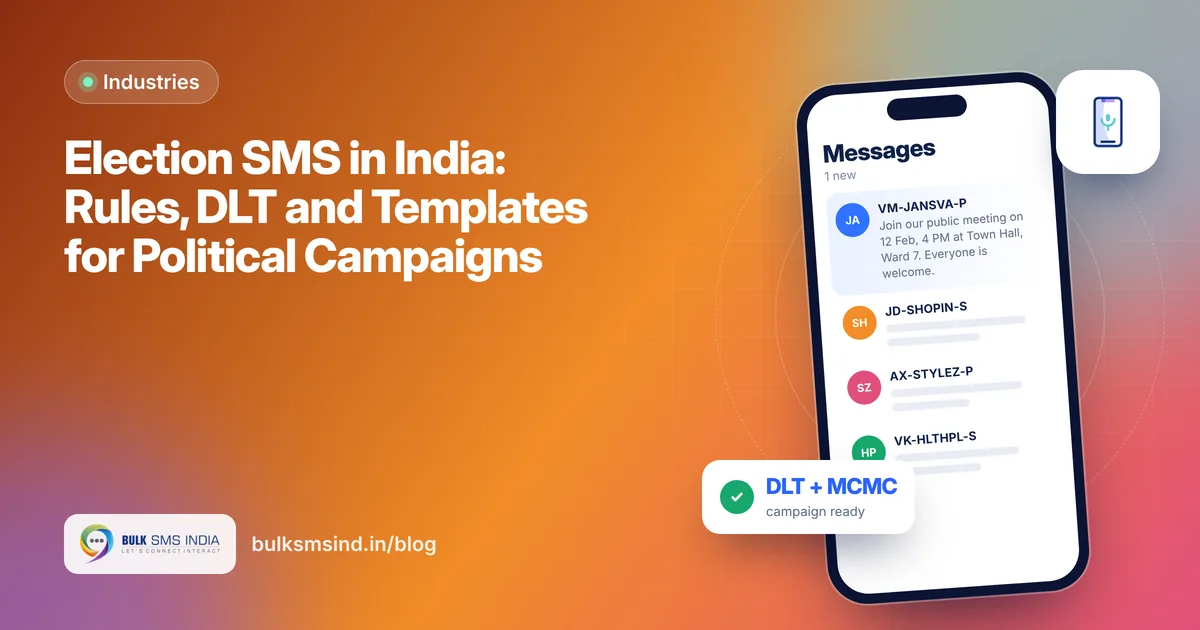
Bulk SMS and voice calls are among the cheapest ways for a party or candidate to reach every voter in a constituency, including people with basic phones. But election messaging in India has its own rules, and breaking them can bring notices from the Election Commission and blocked messages from operators.
This guide covers what is allowed, what needs approval and when you must stop, with sample templates you can adapt.
Upcoming assembly elections
Several state assemblies complete their terms in 2027, so campaign teams are already planning:
| State | Expected polls |
|---|---|
| Goa, Manipur, Punjab, Uttar Pradesh, Uttarakhand | Early 2027 |
| Himachal Pradesh, Gujarat | Late 2027 |
Final dates are announced by the Election Commission of India (ECI). The Model Code of Conduct applies from the day the schedule is announced, so get your DLT registration and templates ready well before that.
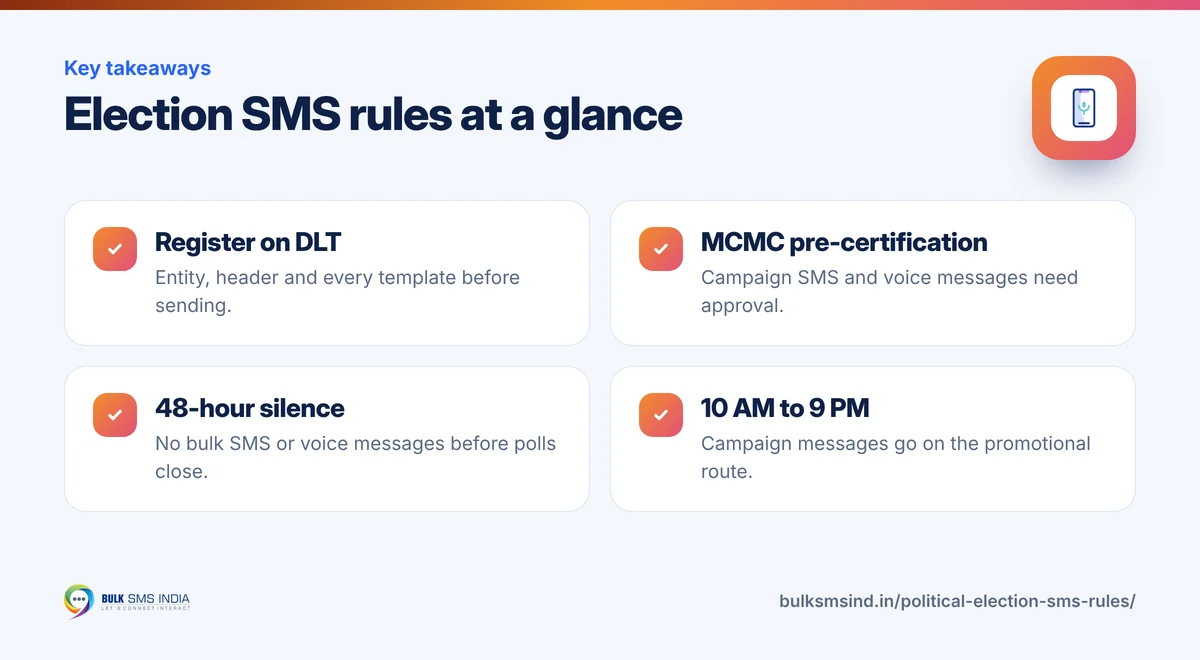
The 5 rules every campaign must follow
1. Register on DLT before you send anything
Like every business sender, a party, candidate or campaign agency must register on a DLT platform:
- Entity: the party, candidate or the agency running the campaign.
- Header (sender ID): for example a short form of the party or candidate name.
- Templates: every message, with names, dates and booth details marked as {#var#}.
Messages that don't match a registered template are blocked by the operator. Campaign messages are generally registered as promotional, which means they go out only between 10 AM and 9 PM and do not reach numbers on DND. Our DLT registration guide explains the steps.
2. Get political ads pre-certified by the MCMC
The ECI has brought bulk SMS and voice messages used for campaigning under pre-certification, along with TV, radio and social media ads. Parties and candidates apply to the Media Certification and Monitoring Committee (MCMC) at the district or state level before the messages go out. Keep the certificate with your campaign records.
3. Stop during the 48-hour silence period
In the 48 hours ending with the close of polling, election campaigning must stop. The ECI's instructions specifically include bulk SMS and voice messages in this ban. Schedule your last campaign message well before the silence period starts, and pause every scheduled campaign for that constituency.
4. Follow the Model Code of Conduct
Campaign messages must follow the same Model Code of Conduct as speeches and posters: no appeals on the basis of caste or religion, no false claims about opponents, and no inducements to voters.
5. Keep records of every campaign
Campaign spending is reported to the Election Commission. Keep invoices, the number of messages sent, the template used and the delivery reports for each campaign.
This guide is general information, not legal advice. Always follow the latest ECI instructions for your election.
What messages work in an election campaign
- Candidate introduction with name, symbol and constituency
- Public meeting and rally invites with date, time and place
- Manifesto highlights with a link to the full document
- Door-to-door visit notices for a ward or village
- Volunteer coordination for booth workers
- Voter awareness: polling date, how to find your booth, ID documents to carry
- Thank you messages after the result
What your customer sees
- DLT-approved sender ID and template
- Submitted to operators in real time
- Live delivery report for every number
- Works on every mobile phone
Sample election SMS templates
Register these on DLT with your own details. Replace each [bracket] with {#var#}.
Candidate introduction
Namaskar! I am [Name], your [Party] candidate from [Constituency]. Your support and blessings matter. Vote for [Symbol] on [Date].
[Name], [Party] candidate for [Constituency], invites your suggestions for the area: [Number]. Vote [Symbol] on [Date].
Rally and meeting invites
Join [Name] at a public meeting on [Date], [Time] at [Place], [Constituency]. Everyone is welcome.
Jan sabha: [Name] will meet residents of [Ward] on [Date] at [Time], [Place]. Please join us.
Voter awareness
Polling in [Constituency] is on [Date], 7 AM to 6 PM. Carry your voter ID or another approved ID. Find your booth: [Link]
Every vote counts! Please vote on [Date] and bring your family along. - [Name], [Party]
Volunteer and booth workers
Booth meeting for [Ward] volunteers on [Date] at [Time], [Place]. Please confirm: [Number]
Dear volunteer, your booth is [Booth No.], [Place]. Report by [Time] on [Date]. Contact: [Number]
Hindi templates
नमस्कार! मैं [Name], [Constituency] से आपका प्रत्याशी। [Date] को [Symbol] पर वोट दें।
[Date] को मतदान करें। अपना वोटर ID साथ लाएं।
Namaskar! Main [Name], [Constituency] se aapka pratyashi. [Date] ko [Symbol] par vote karein.
Hindi messages use Unicode, so one SMS holds 70 characters. See SMS character limit.
Thank you after the result
Thank you, [Constituency], for your trust and support. I will work for every family in our area. - [Name]
Voice calls: the other half of a campaign
Many voters in villages and small towns respond better to a recorded voice call than a text. A 30-second message in the candidate's own voice, in the local language, works well for rally invites and polling-day reminders. Voice calls follow the same rules as SMS: pre-certification, DLT and the silence period. See our voice call service.
Election campaign checklist
- Entity, header and templates registered on DLT
- MCMC pre-certification for campaign messages
- Voter or supporter list cleaned, with invalid numbers removed
- Messages within 160 characters (or 70 for Hindi)
- Campaigns scheduled only between 10 AM and 9 PM
- All campaigns paused before the 48-hour silence period
- Invoices and delivery reports saved for expenditure records
Frequently asked questions
Can political parties send bulk SMS in India?
Yes. Parties and candidates can send bulk SMS if they are registered on DLT, use approved templates, get campaign messages pre-certified by the MCMC and follow the Model Code of Conduct.
Is bulk SMS allowed during the silence period?
No. The Election Commission bans bulk SMS and voice messages for campaigning during the 48 hours ending with the close of polling.
Do election SMS need MCMC approval?
Yes. The Election Commission has brought bulk SMS and voice messages used in campaigns under pre-certification by the Media Certification and Monitoring Committee.
Can election SMS reach DND numbers?
Campaign messages are generally sent on the promotional route, which does not deliver to numbers on the DND list and works only between 10 AM and 9 PM.
Should we use SMS or voice calls for election campaigns?
Use both. SMS is quick and cheap for dates and booth details, while voice calls in the local language build a personal connection, especially in rural areas.
Ready to get started?
Talk to our team about voice call service — setup help, DLT guidance and test credits.
Messaging specialists with 10+ years of experience (since 2016) helping 15,000+ Indian businesses with bulk SMS, WhatsApp, RCS and voice communication.