Bulk SMS Marketing in India: Strategies to Reach More Customers
Proven bulk SMS marketing strategies for Indian businesses — building a list, segmenting, timing, writing, personalising and measuring SMS campaigns.
 Bulk SMS India Team 4 min read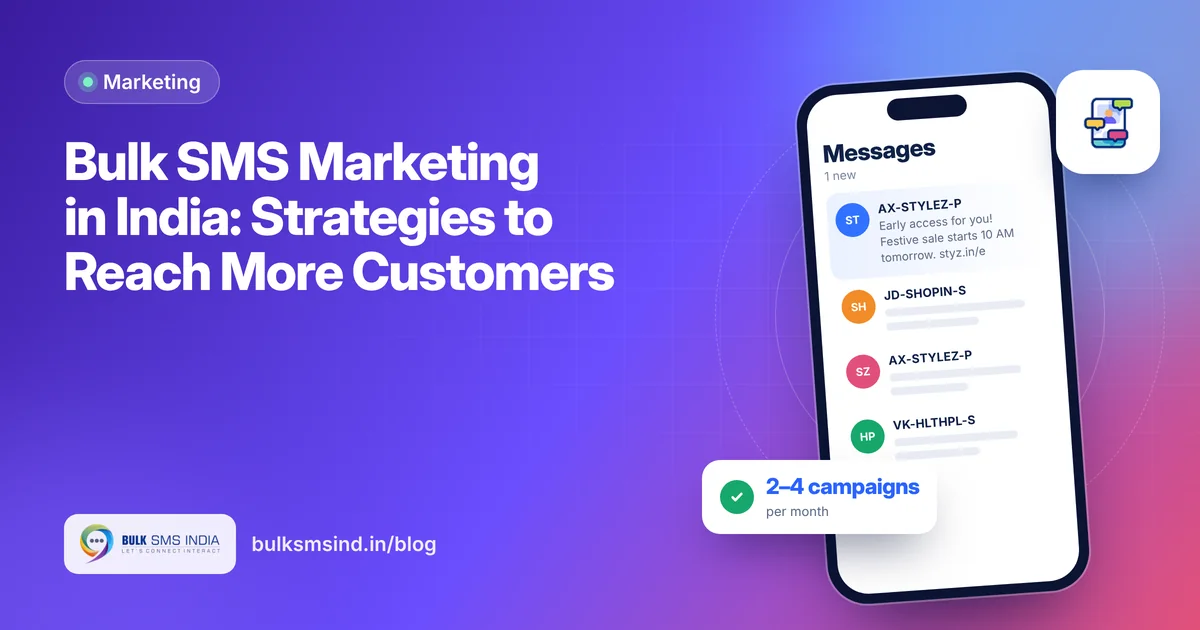
Bulk SMS marketing is one of the few channels that reaches every customer in India, from metro smartphone users to small-town shoppers on basic phones. Done well, it brings in steady sales at a very low cost per customer. Done badly, it annoys people and gets your sender blocked.
Here are the strategies that separate profitable SMS campaigns from ignored ones.
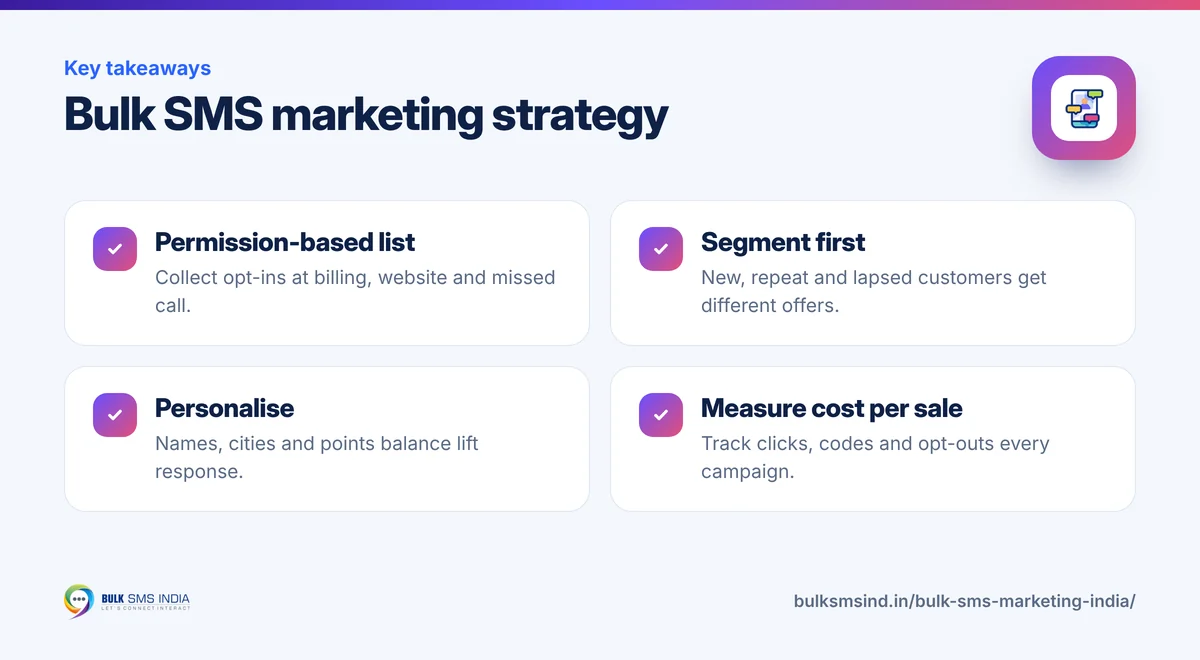
1. Build a permission-based list
The best SMS list is one customers joined willingly. Collect numbers at:
- Billing counters – "Get offers on SMS?"
- Website and checkout pages with a clear opt-in checkbox.
- Missed call campaigns – "Give a missed call to get 10% off."
- Events, exhibitions and walk-ins using a simple form.
Avoid purchased databases. They bring complaints, low response and blocked sender IDs.
2. Segment before you send
Sending the same message to everyone is the fastest way to lose attention. Split your list by:
- Purchase history – new, repeat, lapsed customers.
- Location – city or store nearest to them.
- Interest – category or product they browsed or bought.
- Value – high spenders get early access.
A smaller, relevant send usually earns more than a large generic one.
3. Write messages people act on
- Put the offer first: "Flat 40% off shoes" in the first line.
- Keep it within 160 characters so it stays one SMS.
- Add one link or one number, not several.
- Include a deadline: "Till Sunday" or "Today 4–8 PM".
- End with your brand name so people recognise you.
What your customer sees
- DLT-approved sender ID and template
- Submitted to operators in real time
- Live delivery report for every number
- Works on every mobile phone
4. Personalise
Use template variables to include the customer's name, city, last product or loyalty points. "Ravi, your 450 points expire Sunday" beats "Dear customer, points are expiring".
5. Time it right
Promotional SMS can be delivered only between 10 AM and 9 PM. Within that window:
| Business | Good time to send |
|---|---|
| Food and restaurants | 11:30 AM – 12:30 PM, 6 – 8 PM |
| Retail and fashion | 5 – 8 PM, weekends |
| Education and coaching | 4 – 7 PM, when parents are home |
| Real estate | Friday evening, weekends |
| B2B services | 11 AM – 1 PM on weekdays |
Test, measure and adjust for your own audience.
6. Plan a calendar, not one-off blasts
Map your SMS campaigns to festivals, seasons and your own sales cycle: Diwali, Navratri, Eid, wedding season, back-to-school, year-end sales. Plan two to four campaigns a month, not daily blasts.
7. Combine SMS with WhatsApp and RCS
Use SMS for reach and urgency, and richer channels for detail:
- Send a short SMS to everyone, and a WhatsApp catalogue to customers who opted in.
- Use RCS to send images, carousels and buttons in the native inbox of Android users.
- Use a missed call number in print ads to capture leads who then receive an SMS.
Bulk SMS India runs SMS, WhatsApp and RCS from one account.
8. Measure what matters
Track every campaign beyond "sent":
- Delivery rate from live delivery reports.
- Click-through rate using trackable short links.
- Conversion rate using campaign-specific coupon codes.
- Cost per sale = campaign cost ÷ number of sales.
- Opt-out rate – if it rises, you are sending too often or to the wrong people.
9. Stay compliant
Use DLT-approved promotional templates, whitelist the links you use, honour opt-outs and stay within allowed hours. Compliance is not just about rules; it keeps your messages delivered.
A simple campaign example
A clothing store with 20,000 opted-in customers sends:
- Day 1, 6 PM: "Festive sale starts tomorrow: up to 50% off. Early access for you from 10 AM: {link}"
- Day 3, 5 PM to non-buyers: "Last 2 days! Your size is still in stock. {link}"
- Day 5, 11 AM to buyers: "Thank you for shopping! Here's 10% off your next visit: {code}"
Three messages, each relevant to where the customer is, with clear results tracked by link and code.
Frequently asked questions
Can I send bulk SMS marketing messages in Hindi?
Yes. Unicode SMS supports Hindi and other Indian languages, which often feel more personal for regional audiences. Keep them short, since a Unicode SMS holds 70 characters.
How often should I send marketing SMS?
Two to four well-planned campaigns a month suits most businesses. More than that raises opt-outs.
What response rate should I expect?
It varies by industry, offer and list quality. Track clicks and redemptions from your first few campaigns to set your own benchmark.
Ready to get started?
Talk to our team about bulk SMS service — setup help, DLT guidance and test credits.
Messaging specialists with 10+ years of experience (since 2016) helping 15,000+ Indian businesses with bulk SMS, WhatsApp, RCS and voice communication.